How to Verify Your HVAC Contractor Is Licensed in Texas
Published February 16, 2026 — by AMW Cooling & Heating LLC
Hiring an HVAC contractor for your home or small commercial building is a significant decision. You are trusting someone with your comfort, your safety, and often thousands of dollars in equipment and labor. Unfortunately, not every company knocking on your door or running an ad online is properly licensed. In Texas, the Department of Licensing and Regulation (TDLR) oversees all air conditioning and refrigeration (ACR) contractors, and the rules are clear. Here is how to make sure the contractor you hire is legitimate before they ever touch your system.
Why Licensing Matters for Homeowners and Small Businesses
A licensed HVAC contractor has met specific requirements set by the state of Texas. They have demonstrated practical experience, passed an examination, and carry the insurance required to protect you. An unlicensed operator has done none of this. If something goes wrong with the installation or repair, if equipment is damaged, if someone is injured on your property, or if the work does not meet code, you have little recourse with an unlicensed contractor.
For residential and light commercial properties in Conroe and Montgomery County, this is especially important. Improperly installed or serviced HVAC equipment can lead to refrigerant leaks, electrical hazards, carbon monoxide risks from heating systems, voided manufacturer warranties, and failed building inspections.
What Texas Law Requires: TDLR Contractor Licensing
Texas Occupations Code Chapter 1302 and Texas Administrative Code Title 16 Chapter 75 govern air conditioning and refrigeration contracting in the state. Every person or company performing HVAC work for compensation must hold a valid TDLR ACR contractor license. There are no exceptions for small jobs, side work, or handyman services. If someone is charging you to install, repair, or maintain air conditioning or heating equipment, they must be licensed.
License Classes
TDLR issues two classes of contractor licenses:
Class A License — Authorizes work on any size system with no tonnage or BTU limitations. Required for larger commercial projects but also held by many residential contractors.
Class B License — Authorizes work on cooling systems up to 25 tons and heating systems up to 1.5 million BTU per hour. This covers virtually all residential and light commercial work in the Conroe area.
Experience and Examination Requirements
To obtain a contractor license, an applicant must have at least 48 months of practical experience under a licensed contractor within the past 72 months and pass a TDLR competency examination. This is not a weekend certification. It represents years of supervised, hands-on work.
Insurance Requirements
Licensed contractors must carry general liability insurance at specific minimums. For a Class B license, that means at least $100,000 per occurrence and $200,000 aggregate for property and bodily injury coverage. For Class A, the minimums are $300,000 per occurrence and $600,000 aggregate. This insurance exists to protect you. An unlicensed contractor almost certainly carries no such coverage.
Check the Truck: Vehicle Signage Requirements
One of the easiest ways to spot a licensed contractor is before they even step out of their vehicle. Under 16 Texas Administrative Code Section 75.71(g), every air conditioning and refrigeration contracting company must display the following on both sides of all vehicles used for ACR work:
- ✓The company name in letters not less than two inches high
- ✓The TDLR license number of the affiliated licensee in letters not less than two inches high
This is not optional. It is state law. If a truck pulls up to your home with no company name, no license number, or magnetic signs that look hastily applied, that should raise immediate questions. Legitimate contractors proudly display their credentials because they earned them.
When a subcontractor is working at a job site without a marked vehicle present, the site must be identified with a visible sign displaying the contractor's company name and license number, readable from the nearest public street.
At AMW Cooling & Heating, our vehicles clearly display our company name and TDLR license number on both sides, exactly as the law requires. It is one of the first things you should look for when any HVAC company arrives at your property.
Ask for the Technician's Registration Card
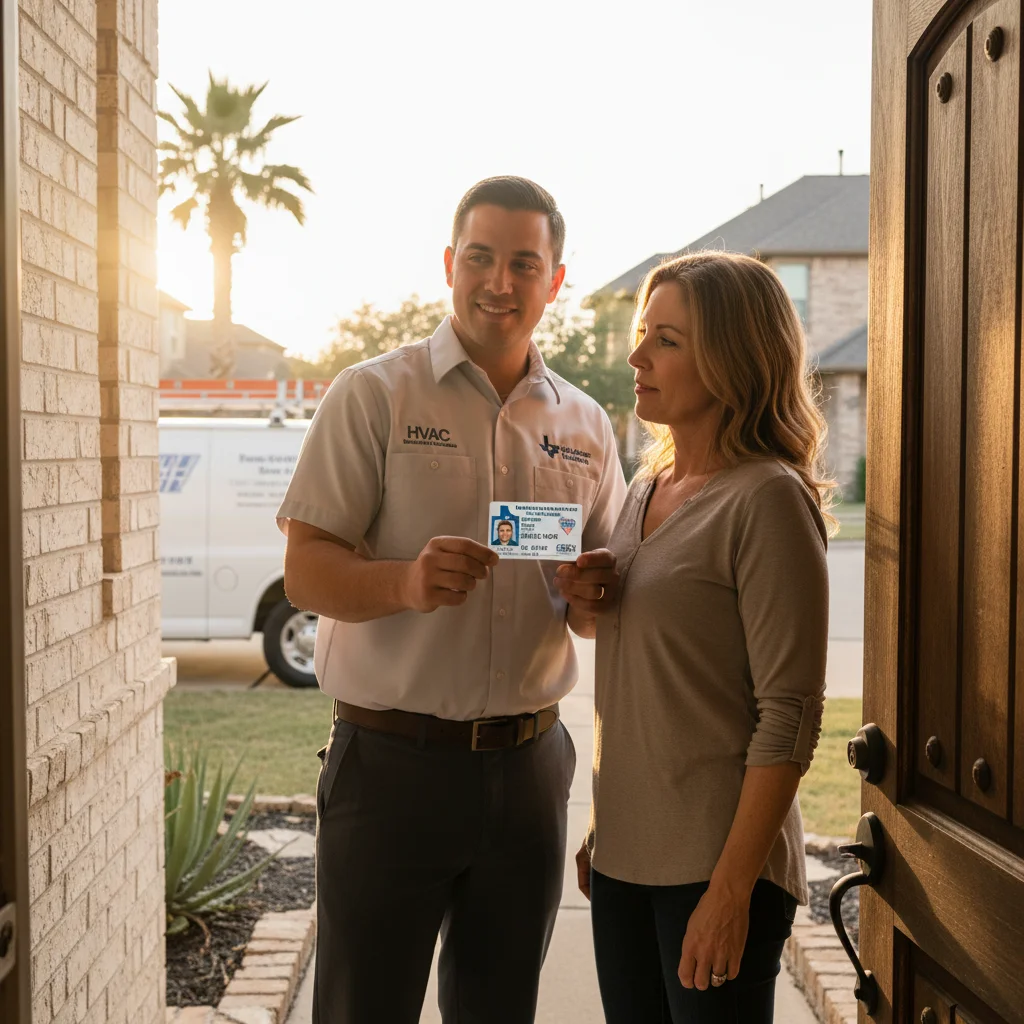
In Texas, it is not just the contracting company that must be credentialed. Every individual technician performing ACR work must hold a valid TDLR registration or certification. Under 16 TAC Section 75.27, there are two levels:
Registered Technician — The entry-level credential. Must be at least 16 years old. Registration costs $20 and is valid for one year. No exam is required, but the technician must work under the supervision of a licensed contractor.
Certified Technician — A higher qualification requiring the technician to be at least 18, complete an approved training program or 24 months of supervised work, and pass a TDLR competency exam.
Both registrations are issued by TDLR and can be verified. If a technician arrives at your home and cannot produce their registration when asked, that is a problem. Under Texas law, they should not be performing ACR work without it. Do not feel uncomfortable asking. Any reputable technician will understand and appreciate that you take the legitimacy of the work seriously.
How to Look Up a Contractor's License Online
TDLR provides a free online license verification tool that any homeowner or business owner can use in under a minute.
Step 1. Visit the TDLR License Search page at tdlr.texas.gov/LicenseSearch.
Step 2. Select "Air Conditioning and Refrigeration" as the license type.
Step 3. Enter the contractor's license number, business name, or individual name.
Step 4. Review the results, which will show the license status (active, expired, or inactive), issue and expiration dates, license class (A or B), endorsements, and any disciplinary actions on record.
If a contractor cannot provide you with a license number, or if the number they give you comes back expired, inactive, or does not match the company name, do not proceed with the work. This verification takes less than a minute and could save you thousands of dollars and significant headaches.
You can also search for enforcement actions and administrative penalties against any contractor at tdlr.texas.gov/cimsfo to see if they have a history of violations.
What Should Appear on Proposals, Invoices, and Contracts
Texas law goes beyond trucks and technician cards. Under 16 TAC Section 75.71(i), all proposals, invoices, contracts, and workplace signage must include:
- ✓The company name, address, and phone number
- ✓The affiliated licensee's TDLR license number
- ✓The statement: "Regulated by The Texas Department of Licensing and Regulation, P.O. Box 12157, Austin, Texas 78711, 1-800-803-9202, 512-463-6599, www.tdlr.texas.gov"
If you receive a quote or invoice that is missing the license number or the TDLR regulation statement, ask for a corrected version before signing anything. Legitimate contractors include this information as a matter of course because it is required on every document.
Advertising Must Include the License Number
Under 16 TAC Section 75.71(h), all advertising designed to solicit HVAC business must include the contractor's TDLR license number. This includes websites, social media ads, flyers, door hangers, yard signs, and online directory listings. There are limited exceptions for national television ads and basic phone book listings, but for the kind of local advertising you encounter in Conroe, The Woodlands, and Spring, the license number should be visible.
If you find a company through an online ad or social media post and there is no license number anywhere, take that as a signal to verify their credentials before engaging further.
Penalties for Unlicensed Work
Texas takes unlicensed HVAC work seriously. Under Texas Occupations Code Section 1302.453, knowingly performing air conditioning and refrigeration contracting without a license is a Class C misdemeanor. TDLR can also impose administrative penalties ranging from $500 to $5,000 depending on the violation class, and can issue cease and desist orders, suspend licenses, or revoke them entirely.
For vehicle signage violations specifically, the penalty is $500 to $1,000 per occurrence. For performing work without proper licensing, penalties range from $1,000 to $3,500 with possible license suspension. Serious violations like misrepresentation, insurance failures, or mechanical integrity issues carry fines of $2,000 to $5,000 plus potential revocation.
These penalties exist to protect consumers like you. When you hire an unlicensed contractor and something goes wrong, there is no regulatory body to turn to, no insurance to file a claim against, and no professional license to revoke.
Red Flags to Watch For
Based on the TDLR requirements, here is a quick checklist of warning signs that the contractor at your door may not be properly licensed:
No signage on the vehicle. Texas law requires the company name and license number in two-inch letters on both sides of every vehicle. No signage means no compliance.
Cannot provide a license number. If they hesitate, change the subject, or say they will get it to you later, verify independently before proceeding.
No license number on the quote or contract. Every proposal and invoice must include the TDLR license number and the regulation statement. Missing information is a compliance failure at minimum.
Cash-only transactions with no written agreement. Licensed contractors provide documented proposals and formal invoices because they are required to keep records for at least three years.
Dramatically lower prices than other quotes. While price varies between companies, a bid that is significantly below everyone else often means the contractor is cutting corners on licensing, insurance, permits, or all three.
Pressure to decide immediately. Legitimate contractors know you may want to verify their credentials and compare quotes. High-pressure tactics are a sign that scrutiny is not welcome.
How to File a Complaint
If you believe an unlicensed contractor has performed work on your property, or if a licensed contractor has violated state regulations, you can file a complaint with TDLR:
- ✓Online: Visit tdlr.texas.gov/complaints-and-enforcement
- ✓Phone: Call 512-463-6599 or 1-800-803-9202
- ✓Mail: Texas Department of Licensing and Regulation, P.O. Box 12157, Austin, TX 78711
Complaints can be filed anonymously. TDLR investigates all complaints and has the authority to impose penalties, issue orders, and take enforcement action.
Protect Your Home and Your Investment
Verifying your HVAC contractor's license is one of the simplest steps you can take to protect your home, your family, and your money. It takes less than a minute online, and the information should be clearly visible on the contractor's truck, paperwork, and advertising.
AMW Cooling & Heating LLC is a fully licensed and insured HVAC contractor serving Conroe, The Woodlands, Spring, Magnolia, Willis, Montgomery, Tomball, and all of Montgomery County. We proudly display our TDLR credentials on our vehicles, our website, and every document we provide because we believe transparency is the foundation of trust.
If you need HVAC service for your home or light commercial property, or if you want to verify our credentials before scheduling, call us at (936) 331-1339. We welcome the question because we have nothing to hide.