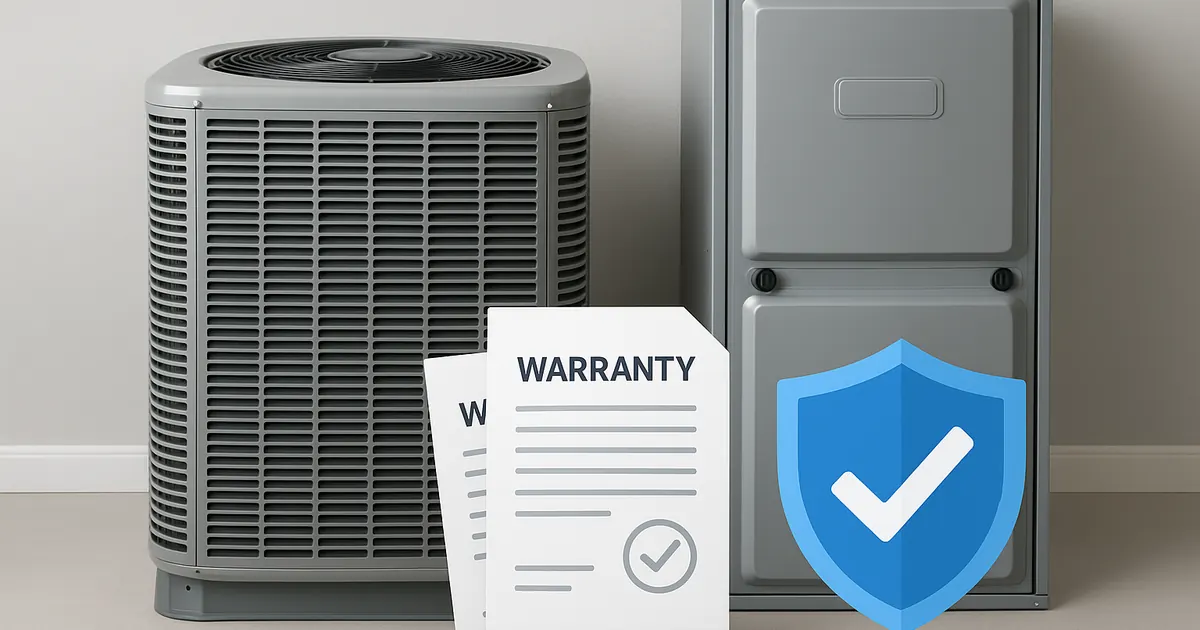
Understanding HVAC Warranties: What Every Conroe Homeowner Needs to Know Before Buying
Purchasing a new HVAC system is one of the largest investments you'll make in your Conroe home. A quality system can cost $5,000 to $15,000 or more, so understanding warranty protection before you buy is essential. Unfortunately, warranty coverage is often misunderstood, leading to frustration when homeowners discover their "10-year warranty" doesn't cover what they expected.
At AMW Cooling & Heating, we help our customers understand exactly what they're getting before they sign. This guide explains HVAC warranties in plain language so you can make informed decisions and protect your investment.
Have questions about warranties on your current or future HVAC system? Call AMW Cooling & Heating at (936) 331-1339 for honest answers.
Types of HVAC Warranties
HVAC warranties come in several varieties, each covering different aspects of your system. Understanding these distinctions helps you evaluate what you're actually getting.
Manufacturer's Parts Warranty
This warranty covers defective components—compressors, heat exchangers, coils, motors, circuit boards, and other parts that fail due to manufacturing defects. It's provided by the equipment manufacturer (Carrier, Trane, Lennox, Goodman, etc.) and typically the longest-lasting warranty you'll receive.
Standard coverage: Most manufacturers offer 5-10 years on parts, with premium lines sometimes extending to 12 years.
What it covers: Replacement parts when components fail due to defects.
What it doesn't cover: Labor to diagnose problems and install replacement parts. This is crucial—a warranty part still requires a service call to install.
Manufacturer's Compressor or Heat Exchanger Warranty
Many manufacturers offer extended warranties on these critical, expensive components:
Compressor warranties: The compressor is the heart of your air conditioning system and one of the most expensive components to replace (often $1,500-3,000 installed). Many manufacturers warranty compressors for 10 years, with some premium units covered for 12 or even lifetime.
Heat exchanger warranties: The heat exchanger is the critical component in your furnace where combustion gases transfer heat to your home's air. A cracked heat exchanger is a serious safety hazard. Many manufacturers warranty heat exchangers for 20 years to lifetime.
Important note: These extended warranties typically cover ONLY the specified component. A lifetime heat exchanger warranty doesn't mean other furnace parts are covered for life.
Labor Warranty
Labor warranties cover the cost of technician time to diagnose and repair problems. This warranty typically comes from your installing contractor, not the manufacturer.
Standard coverage: Most reputable contractors offer 1-2 years of labor warranty on new installations.
Extended labor coverage: Some contractors offer extended labor warranties (5-10 years) for an additional cost. These can be valuable since labor often exceeds parts cost for many repairs.
What to watch for: Some contractors offer minimal labor warranties to lower their bid price. A great equipment price with a 30-day labor warranty isn't actually a great deal.
Contractor's Workmanship Warranty
Separate from the labor warranty, a workmanship warranty covers installation defects—improperly connected refrigerant lines, inadequate electrical work, ductwork problems, and similar installation errors.
Quality contractors stand behind their work with meaningful workmanship warranties. If problems stem from how the system was installed, the contractor should fix them at no charge.
What Voids HVAC Warranties
Your warranty is only as good as your compliance with its requirements. Here's what can void your warranty protection:
Failure to Register the Equipment
Many manufacturer warranties require registration within 60-90 days of installation. Unregistered equipment may receive only a limited base warranty (often 5 years instead of 10).
Who should register: Your installing contractor should handle registration, but verify this was done. Ask for confirmation of your warranty registration.
How to check: Most manufacturers allow you to verify registration online by entering your equipment serial number.
Improper Installation
Manufacturers require proper installation according to their specifications. Common installation errors that can void warranties include:
- ✓Incorrect refrigerant charge
- ✓Improper electrical connections
- ✓Inadequate airflow across coils
- ✓Wrong sizing for the application
- ✓Failure to follow manufacturer's installation instructions
This is why choosing a qualified, experienced contractor matters. A cut-rate installation that voids your warranty costs far more in the long run.
Lack of Professional Maintenance
Most manufacturer warranties require annual professional maintenance to remain valid. This isn't a marketing gimmick—proper maintenance genuinely prevents premature failures and helps systems last their expected lifespan.
What you need: An annual tune-up by a licensed HVAC technician, typically performed in spring for cooling systems and fall for heating systems.
Documentation matters: Keep records of every maintenance visit. If you ever need warranty service, you may need to prove your system was properly maintained.
DIY Repairs or Unlicensed Service
Having unqualified individuals work on your HVAC system can void the warranty. This includes:
- ✓DIY repairs beyond basic filter changes
- ✓Service by unlicensed "handymen"
- ✓Repairs using non-approved parts
- ✓Modifications to the equipment
Always use licensed HVAC professionals for any work beyond routine filter changes.
Using Non-Approved Refrigerants or Parts
Installing aftermarket parts or unapproved refrigerants can void your warranty. If your contractor suggests alternatives to manufacturer-specified components, understand this may affect your warranty coverage.
Understanding Warranty Limitations
Even valid warranties have important limitations:
Parts Only vs. Parts and Labor
This is the most common source of warranty confusion. A "10-year parts warranty" sounds comprehensive, but consider this scenario:
Your 7-year-old system's blower motor fails. The motor is covered under warranty—free replacement part. But diagnosing the problem, removing the old motor, installing the new one, and testing the system takes 2-3 hours of technician time. At typical service rates, you might pay $300-500 in labor for your "free" warranty repair.
The lesson: Parts warranties help, but budget for potential labor costs on older systems still under parts warranty.
Proration
Some warranties are prorated, meaning coverage decreases over time. A 10-year prorated warranty might cover:
- ✓Years 1-5: 100% of parts cost
- ✓Years 6-7: 75% of parts cost
- ✓Years 8-9: 50% of parts cost
- ✓Year 10: 25% of parts cost
Non-prorated warranties cover the full replacement cost throughout the warranty period. These are more valuable but less common.
Original Owner Only
Many manufacturer warranties apply only to the original purchaser and are non-transferable. If you buy a house with a 3-year-old HVAC system, the remaining warranty may not transfer to you.
Transferable warranties are available from some manufacturers, sometimes for an additional fee. If you plan to sell your home, a transferable warranty adds value.
Exclusions and Conditions
Read warranty documents carefully. Common exclusions include:
- ✓Damage from power surges or lightning
- ✓Damage from floods, fires, or other disasters
- ✓Normal wear and tear on consumable parts
- ✓Damage from improper use or neglect
- ✓Consequential damages (like water damage from a failed system)
Extended Warranties and Service Agreements
Beyond manufacturer warranties, you may be offered extended protection:
Extended Parts Warranties
Manufacturers sometimes offer extended warranty coverage for an additional cost at time of purchase. These extensions typically add years to the base parts warranty.
Value assessment: Calculate the cost per year of additional coverage. If extending from 10 to 12 years costs $500, you're paying $250 per year for that coverage. Is that worth it given the probability of major failures in years 11-12?
Labor Warranties from Contractors
Some contractors offer extended labor warranties covering service calls for 5-10 years. These can be valuable but evaluate them carefully:
Consider the contractor's stability: Will this company be around in 10 years to honor the warranty? A warranty from a fly-by-night operation has no value.
Read the fine print: What exactly is covered? Some "labor warranties" exclude diagnostic time or have per-visit caps.
Compare the cost: If extended labor coverage adds $1,000 to your installation cost and covers 10 years, you're paying $100/year. Typical service calls run $100-200, so you'd need one covered call every 1-2 years to break even.
Home Warranties (Third-Party)
Separate from HVAC-specific warranties, whole-home warranty companies offer coverage that includes HVAC systems. These deserve careful evaluation:
Potential benefits:
- ✓Single service fee for covered repairs
- ✓Budget predictability
- ✓Coverage for multiple home systems
Common complaints:
- ✓Long wait times for service
- ✓Use of lowest-cost contractors
- ✓Denial of claims for pre-existing conditions
- ✓Coverage limits that don't cover full repair costs
- ✓Frustrating claims processes
Our experience: At AMW Cooling & Heating, we've seen mixed results with home warranty companies. Some homeowners appreciate the coverage; others find the experience frustrating. Research specific companies thoroughly before purchasing.
What to Look for When Buying a New System
When shopping for HVAC equipment, consider warranty coverage as part of your evaluation:
Key Questions to Ask
Parts warranty length: How many years are parts covered? Is coverage prorated?
Compressor/heat exchanger warranty: Are these critical components covered longer than standard parts?
Registration requirements: What's required to activate the full warranty? Who handles registration?
Labor warranty: What does the installing contractor offer? How long? What's covered?
Maintenance requirements: What professional maintenance is required to keep the warranty valid?
Transferability: Can the warranty transfer to new owners if you sell the home?
Comparing Warranty Value
A lower-priced system with a shorter warranty may cost more long-term than a premium system with better coverage. Consider total cost of ownership:
System A: $6,000 installed with 5-year parts warranty System B: $7,500 installed with 10-year parts warranty
If System A needs a $600 repair in year 7 that would have been covered under System B's warranty, the effective price difference narrows considerably.
Beware of "Lifetime" Claims
"Lifetime warranty" sounds impressive but read carefully:
- ✓Whose lifetime? The equipment's lifetime (as determined by the manufacturer) or yours?
- ✓What's actually covered? A lifetime compressor warranty covers one component, not the whole system
- ✓What are the conditions? Lifetime warranties often have strict maintenance and registration requirements
Maintaining Your Warranty Protection
To ensure your warranty remains valid and you can actually use it when needed:
Register Your Equipment Immediately
Don't assume your contractor handled this. Within 30 days of installation:
- ✓Ask your contractor for warranty registration confirmation
- ✓If they didn't register, do it yourself on the manufacturer's website
- ✓Keep the confirmation email or registration documents
Schedule Annual Maintenance
Professional maintenance is typically required and genuinely beneficial:
- ✓Schedule cooling system maintenance each spring
- ✓Schedule heating system maintenance each fall
- ✓Keep all maintenance records with your warranty documents
AMW Cooling & Heating offers maintenance plans that satisfy warranty requirements and keep your system running efficiently. Call (936) 331-1339 to learn more.
Document Everything
Create an HVAC file containing:
- ✓Purchase contract and receipts
- ✓Warranty registration confirmation
- ✓Equipment model and serial numbers
- ✓All maintenance records with dates and technician names
- ✓Any repair invoices
This documentation protects you if warranty claims are questioned.
Use Licensed Contractors
For any work beyond filter changes, use licensed HVAC professionals. Verify licensing before any service:
- ✓Texas requires HVAC contractors to hold a TACL license
- ✓AMW Cooling & Heating license: TACLB133920E
- ✓Ask any contractor for their license number before they work on your system
What to Do When You Need Warranty Service
If your system fails and you believe it should be covered under warranty:
Step 1: Gather Documentation
Before calling, locate:
- ✓Equipment serial and model numbers
- ✓Warranty registration information
- ✓Maintenance records
- ✓Original purchase documentation
Step 2: Contact a Licensed Contractor
Your installing contractor is usually the best first call—they know your system and have records of the installation. If they're unavailable or you've moved, any licensed contractor can perform warranty service.
Note: The contractor will typically charge a diagnostic fee to determine what's wrong. This is standard and separate from warranty coverage.
Step 3: Understand the Process
For most warranty claims:
- ✓Contractor diagnoses the problem
- ✓Contractor identifies the failed part
- ✓Contractor contacts the manufacturer or distributor
- ✓Warranty coverage is verified
- ✓Replacement part is ordered
- ✓Part is installed; labor is billed to homeowner (unless covered by labor warranty)
Step 4: Know Your Options
If a warranty claim is denied, you have options:
- ✓Request written explanation of denial
- ✓Review your warranty terms carefully
- ✓Contact the manufacturer directly to appeal
- ✓File complaints with the Better Business Bureau or Texas HVAC licensing board if appropriate
The AMW Warranty Commitment
At AMW Cooling & Heating, we believe in standing behind our work:
Our Standard Coverage
- ✓Full parts warranty per manufacturer terms (typically 10 years on major components)
- ✓Labor warranty on all new installations
- ✓Workmanship guarantee on all installation work
- ✓We handle warranty registration so you don't have to
Our Maintenance Plans
Our maintenance agreements are designed to protect your warranty while keeping your system efficient:
- ✓Annual precision tune-ups (cooling and heating)
- ✓Priority scheduling for service calls
- ✓Discounts on repairs
- ✓Documentation that satisfies warranty requirements
- ✓Peace of mind knowing your investment is protected
Why Warranty Coverage Matters to Us
As a veteran-owned company, we understand that trust and reliability matter. We want customers for life, and that means providing warranty coverage you can count on and service that honors the commitments we make.
Ready to discuss new HVAC equipment or protect your current system with professional maintenance? Call AMW Cooling & Heating at (936) 331-1339.
AMW Cooling & Heating serves Conroe, The Woodlands, Montgomery, Willis, Spring, and surrounding Montgomery County with honest, professional HVAC service backed by meaningful warranties and service you can trust.